A Practical TRI Crosswalk to Other Environmental Reporting Requirements
Environmental Reporting Is More Interconnected Than It Appears
Every spring, industry prepares reports across numerous regulatory programs. The Toxics Release Inventory (TRI) is unique in that it overlaps with nearly every other facility-level reporting requirement. From company-specific sustainability disclosures to formal emissions inventory reporting, much of the underlying data ultimately feeds into the TRI report.
For facilities without a centralized reporting system, this overlap often leads to duplicated effort, inconsistent assumptions, and missed opportunities to reconcile data across programs. This challenge is compounded by the fact that each program poses slightly different questions about the same set of chemicals or excludes chemicals that are otherwise subject to TRI requirements. With sufficient planning, however, TRI calculations can serve as a central reporting hub by bringing together data from multiple regulatory programs and supporting a more consistent, defensible approach to environmental reporting.
What Makes TRI the “Hub”?
The TRI program, established under the Emergency Planning and Community Right‑to‑Know Act (EPCRA) and codified at 40 CFR Part 372, requires certain facilities to report annual releases and waste management activities for listed chemicals. Applicability is based on industry classification, employee thresholds, and chemical activity levels. Facilities that meet these criteria submit reports through EPA’s TRI-MEweb system, with reported data becoming publicly available.
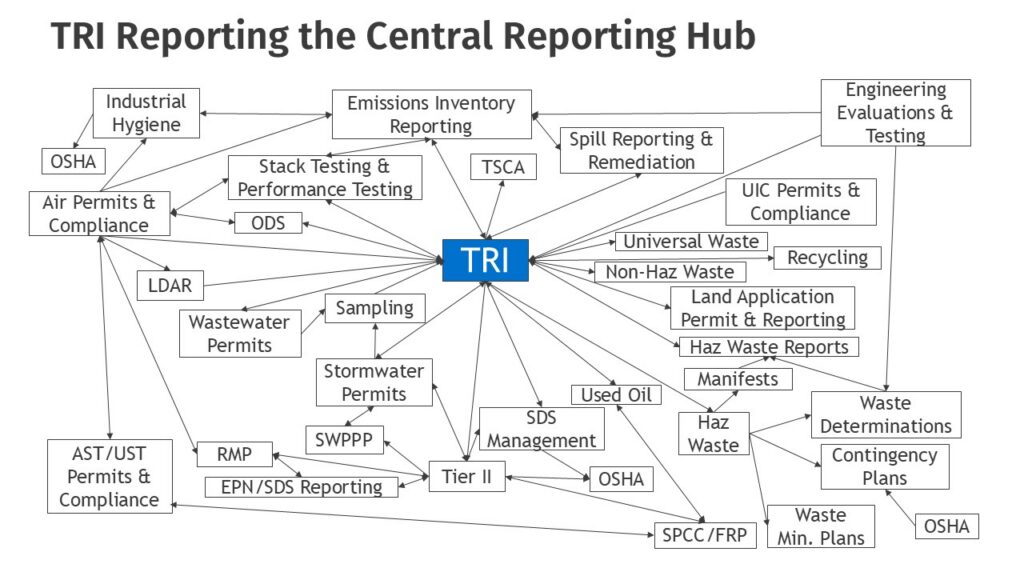
Unlike other environmental programs that focus on a single medium or regulatory objective, TRI is inherently multimedia in nature. TRI reporting captures air emissions, wastewater and stormwater discharges, off‑site waste transfers, onsite treatment and recycling, spills, remediation activities, and overall chemical use. Because of this breadth, TRI relies on data generated across nearly every operational area of a facility.
This comprehensive scope makes TRI well suited to function as a central framework hub for collecting and reconciling environmental data. When TRI threshold determinations and release calculations are developed with awareness of other reporting obligations, facilities can reduce duplication, improve internal consistency, and gain a more complete understanding of facility‑wide chemical management.
One Chemical Story, Multiple Reporting Lenses
While TRI overlaps extensively with other environmental reporting programs, each program applies its own rules, thresholds, and assumptions. Understanding where alignment is expected and where differences are appropriate is essential for accurate and defensible compliance. The sections below describe how TRI intersects with some of the most common facility‑level reporting requirements.
Tier II Chemical Inventory
Tier II Chemical Inventory reporting applies to facilities that are required to maintain Safety Data Sheets (SDSs) for hazardous chemicals under OSHA and that store those chemicals above applicable thresholds. Tier II reports are submitted annually by March 1 and are governed by 40 CFR Part 370. The program is intended to support emergency planning and community right to know by identifying hazardous chemicals present onsite.
Tier II and TRI reporting share common objectives, overlapping chemical coverage, and reliance on the same underlying data sources, including SDSs and composition information. However, these programs diverge in important ways. TRI applies more detailed concentration rules than Tier II, includes wastes and chemicals in process when determining maximum onsite quantities, and uses exemption criteria that do not always align with Tier II requirements. These differences mean that data developed for Tier II cannot always be carried over directly without adjustment.
Despite these distinctions, TRI functions well as a central reporting hub. Tier II reporting typically establishes a facility’s chemical inventory baseline, making it a logical starting point for evaluating materials for TRI applicability and maximum onsite evaluations. When TRI is treated as the hub, Tier II data becomes a foundational input rather than a parallel effort, reducing data duplication and time required to review SDSs; ultimately improving consistency across both programs.
Emissions Inventory
Air emissions inventory requirements are established through State Implementation Plans under the Clean Air Act and vary by state. Title V sources are typically required to submit annual emissions inventories, while reporting requirements for minor sources depend on state‑specific rules and exemptions. Emissions inventories are designed to support regulatory oversight and air quality planning by quantifying emissions from stationary sources.
Emissions inventory reporting and TRI share many common data inputs, including stack and fugitive emission estimates, emission factors, throughput data, and stack testing or monitoring results. Many hazardous air pollutants reported in emissions inventories are also TRI‑listed chemicals. Differences arise in scope and methodology. Emissions inventories may exclude insignificant sources or exempt emission units that must still be included in TRI reporting. States may also prescribe specific emission factors or require the use of maximum potential emissions, whereas TRI requires the use of the best readily available and site‑specific information. Applicability thresholds also differ, meaning that emissions not required to be reported under state inventory programs may still need to be evaluated and reported under TRI (and vice versa).
Emissions inventory development provides much of the initial information needed for TRI air release reporting. Treating TRI as a central reporting hub allows facilities to consolidate emissions data, reconcile programmatic differences, and evaluate air releases in a more integrated manner. This integrated approach can help identify potential compliance risks earlier, particularly when TRI‑reported emissions approach regulatory thresholds that may trigger additional air program obligations.
Waste Reporting
Hazardous waste reporting under the Resource Conservation and Recovery Act (RCRA) requires large quantity generators to report waste quantities and management methods, typically through the Biennial Report or state specific waste reports. These reports focus on hazardous waste and are intended to support waste management oversight and environmental protection.
Waste reporting and TRI overlap in their reliance on waste characterization data, including chemical identity, composition, and process knowledge. Many TRI‑listed chemicals ultimately become hazardous wastes when discarded or managed as waste. The primary distinction lies in scope. TRI reporting captures all waste and recycle streams associated with TRI‑listed chemicals, including hazardous waste, non‑hazardous industrial waste, universal waste, and even routine trash disposed of in landfills. RCRA reporting, by contrast, represents only a subset of the waste streams evaluated under TRI. Concentration assumptions may also differ, as hazardous waste determinations often rely on conservative or TCLP‑based assumptions that do not directly translate to TRI constituent quantities.
Waste reporting data developed for RCRA and state programs provides key inputs to TRI, including waste quantities, chemical identity, and management methods. Using TRI as the central reporting hub helps ensure that waste streams are not overlooked under either program and that final disposal and management pathways are evaluated consistently. This integrated approach supports reconciliation between waste and TRI reporting, recognizing that EPA reviews both programs for discrepancies and that facilities should be doing the same.
Water Reporting
Water reporting requirements are established under the Clean Water Act through the National Pollutant Discharge Elimination System (NPDES) permitting program. Facilities with permitted wastewater or stormwater discharges are required to monitor and report effluent results and discharge volumes at frequencies specified in their permits.
TRI and NPDES reporting share common data sources, including analytical results, discharge flows, and process knowledge used to estimate annual mass loadings. Many TRI‑listed chemicals are monitored under NPDES permits when discharged to water. Key differences relate to scope and reporting conventions. NPDES reporting is limited to pollutants specified in the permit and to permitted outfalls, while TRI reporting includes all water releases leaving the facility, including nonroutine or episodic discharges. TRI also applies different assumptions when analytical results are reported as nondetect, which can lead to differences between reported values.
NPDES monitoring data is a primary input for TRI water release reporting. Using TRI as a central reporting hub ensures that permitted discharges, stormwater, and other water releases are evaluated together, providing a complete, facility‑wide picture of chemical releases to water and improving the consistency of reporting across programs.
Fewer Silos, a Clearer Chemical Story
Environmental reporting is often managed in silos, with different individuals responsible for different programs and data stored in disconnected systems. This approach increases the likelihood of inconsistent assumptions, missed data, and discrepancies that are difficult to reconcile after the fact.
Treating TRI reporting as the central hub for environmental data collection and evaluation allows facilities to consolidate calculations, align documentation, and clearly justify program‑specific differences. The result is not only stronger TRI reporting, but improved confidence across all environmental compliance obligations.
If you are interested in discussing how a centralized reporting approach can reduce duplication and improve consistency across your environmental reporting programs, contact Misty Sinclair at 319.253.8402, your local Trinity office, or by calling Trinity Consultants at 800.229.6655.


