The Arizona Department of Environmental Quality (ADEQ) announced that the U.S. Environmental Protection Agency (EPA) has approved the redesignation of Northwest Yuma County to attainment status for the 8-hour ozone 2015 National Ambient Air Quality Standard (NAAQS).
Ozone Nonattainment Background in Yuma
Ground-level ozone, a key component of smog, forms when nitrogen oxides (NOX) and volatile organic compounds (VOC), from vehicles, industrial facilities, and other sources react in sunlight. The Clean Air Act (CAA) establishes National Ambient Air Quality Standards (NAAQS) for several regulated air pollutants, including ozone, to protect public health and the environment. Areas that fail to meet the ozone standards are designated as “nonattainment,” meaning ozone levels exceed these limits. Nonattainment status triggers stricter regulatory requirements, planning obligations, and emission reduction measures until the area demonstrates sustained compliance with federal standards.
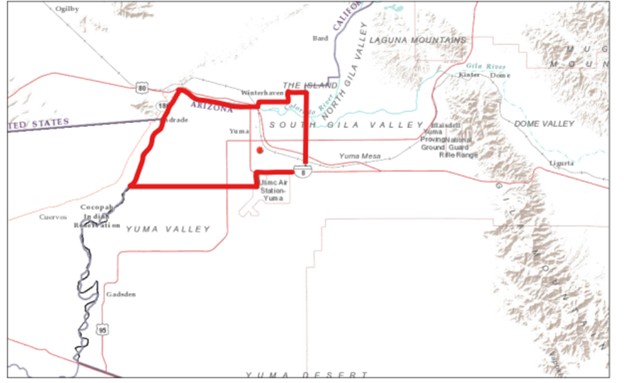
EPA designated northwest Yuma County, see Figure 1 in red boundary, as a marginal nonattainment area on June 4, 2018 for the 2015 ozone NAAQS of 70 parts per billion (ppb), with the classification becoming effective on August 3, 2018. In response, ADEQ collaborated with local governments, industry, and stakeholders to submit a marginal ozone state implementation plan (SIP) revision by December 2020, which included an emissions inventory, modeling for attainment, and new control rules. By October 7, 2022, EPA determined that air quality data from 2018–2020 met the 2015 ozone standards by the August 3, 2021 attainment date. ADEQ then submitted the formal redesignation request and a 10-year maintenance plan in December 2023, pursuant to CAA Section 175A.
Figure 1. Northwest Yuma Ozone Nonattainment Boundary
What’s Next for the Northwest Yuma Area?
EPA’s approval, dated November 18, 2025, confirms that Northwest Yuma County has met the 2015 ozone standards, adopted permanent and enforceable air quality controls, and developed a 10-year maintenance plan to ensure continued compliance meeting CAA Section 175A requirements. The approved maintenance plan, which will guide air quality management through 2037, was developed with local political subdivisions, federal land managers (FLMs), community stakeholders, and residents. ADEQ has shown that through the implementation of Federal vehicle standards, engine standards, and rules for boilers, reciprocating internal combustion engines, and electrical utility generation units, that the reduction are permanent and enforceable.
ADEQ selected 2020 as the base year for the attainment inventory in the Yuma maintenance plan. The Yuma area attained the 2015 ozone NAAQS in 2020, and therefore, the emissions inventory from 2020 represents emissions levels consistent with continued attainment (i.e., maintenance) of the NAAQS. ADEQ has demonstrated through projecting emissions until 2037 that the area will maintain the 70 ppb NAAQS. As such, the portion of Yuma County has satisfied all Clean Air Act (CAA) requirements for redesignation, officially moving from its Marginal nonattainment status to attainment with a Maintenance status. ADEQ will continue to monitor emissions through 2037 to ensure the area maintains the NAAQS.
Eight years after the redesignation date (e.g., November 18, 2033), ADEQ must submit an additional revision of the SIP for maintaining the national primary ambient air quality standard for 10 years after the expiration of the initial 10-year period, pursuant to CAA Section 175A(b).
What if the Area’s Monitored Ozone Concentrations Increase?
In accordance with CAA Section 175A, the maintenance plan contains contingency measures to ensure that any violation of the NAAQS is promptly corrected. ADEQ identifies two triggers as contingency measures, a warning level response and an action level response. The warning level response would be triggered if an annual 4th high monitored concentration is above the level of the 2015 ozone NAAQS. This would initiate an analysis to determine whether the high ozone concentrations indicate a trend towards high ozone levels. The action level response would be triggered if a certified design value exceeds the level of the 2015 ozone NAAQS. Within 18 months of the certified design value exceedance, ADEQ commits to identify and implement necessary control measures, including but not limited to:
- Anti-idling control program for mobile sources, targeting diesel vehicles;
- Diesel exhaust retrofits;
- Traffic flow improvements;
- Park and ride facilities; and
- Rideshare/carpool program.
Conclusion
While the EPA as approved the redesignation, any petitions for judicial review of this action must be filed in the United States Court of Appeals for the appropriate circuit by January 20, 2026. However, filing a petition for reconsideration by EPA does not affect the finality of this action and does not postpone the effective date of this approval.
If you would like to discuss ozone nonattainment in Arizona, please email Thomas Pederson in Trinity’s Phoenix office or call 425.232.9530.


