EPA is proposing a Federal Implementation Plan (FIP) that includes Nonattainment New Source Review (NNSR) regulations for the Mojave Desert Air Quality Management District (MDAQMD) portion of the West Mojave Desert ozone nonattainment area and the San Bernardino County and Trona Planning Area PM10 nonattainment areas. The image below shows a map of the MDAQMD ozone and PM10 nonattainment areas from Docket ID No. EPA-R09-OAR-2024-0228 associated with Federal Register Volume 89, Pages 56237-56250.
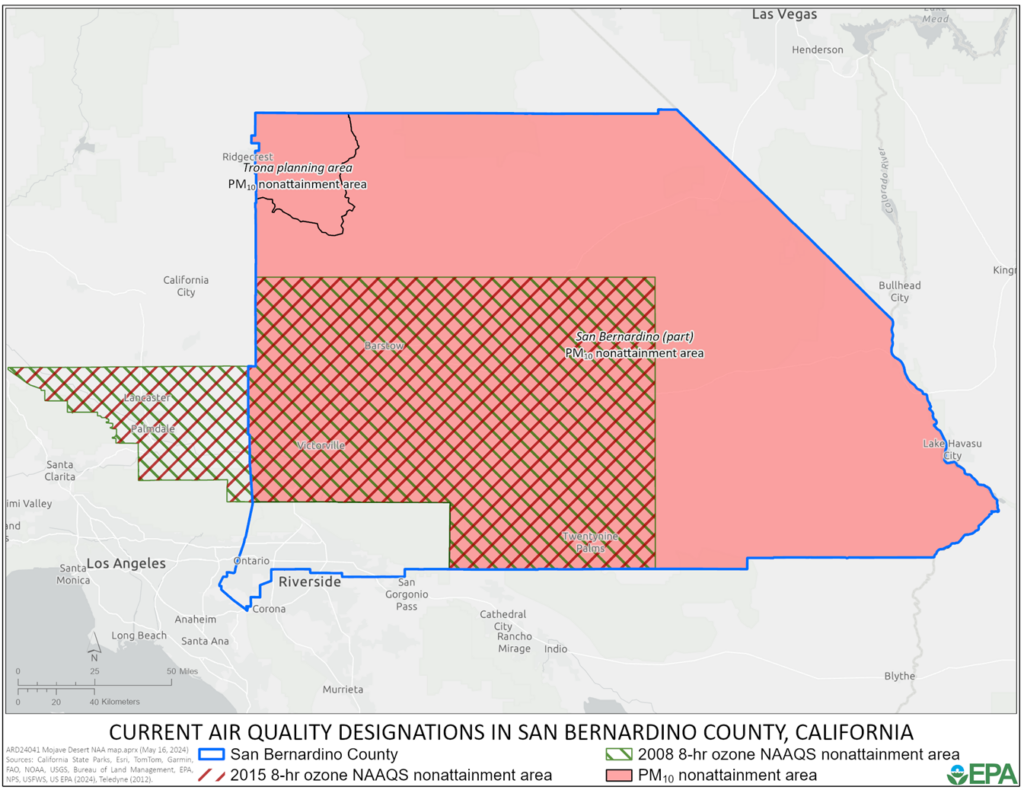
The proposed FIP would apply to the construction of new major stationary sources and major modifications for nonattainment pollutants at existing stationary sources in these MDAQMD nonattainment areas. Per MDAQMD’s news release on the topic, the FIP could impact 37 existing major stationary sources of air pollution with permits issued by MDAQMD if a major modification affecting a nonattainment pollutant was proposed at one of these facilities.
Under MDAQMD Rule 1301, major stationary sources are facilities that emit, or have the potential to emit (PTE), 25 tons per year or more of NOX, SOX, or VOC, or 15 tons per year or more of PM10. Facilities should evaluate if their facility is considered major per the definition in the finalized FIP.
Background
On June 30, 2023, EPA finalized a limited approval and limited disapproval of MDAQMD’s portion of the California State Implementation Plan (SIP) related to MDAQMD’s NNSR rules. In this action, EPA identified six deficiencies in MDAQMD’s NNSR rules that, per EPA, did not fully satisfy the relevant requirements for preconstruction review and permitting under the Clean Air Act (CAA). In turn, MDAQMD worked with EPA to rectify five of the deficiencies and amended its NNSR rules to resolve the disapproval elements. While MDAQMD’s NNSR rules have been amended to correct five of the six deficiencies, these are not yet reflected in the SIP, so all six identified deficiencies are included in EPA’s proposed FIP. The sixth deficiency, however, remains a point of contention between MDAQMD and EPA, and MDAQMD is currently litigating EPA over the issue.
Specifically, the issue relates to MDAQMD Rule 1304, which allows offsets for certain modifications at major sources to be calculated as the difference between the pre- and post-modification PTE of a pollutant (PTE-to-PTE test) rather than requiring pre-modification Historic Actual Emissions to be the pre-project baseline for offsets determination, as required by EPA’s regulations. The use of actual emissions as the pre-project baseline would show a higher net emissions increase (as defined by MDAQMD Rule 1301) than calculations that use potential emissions as the pre-project baseline. EPA clarified that CAA section 173(c)(1) requires the SIP to contain provisions to ensure emission increases from new or modified major stationary sources are offset by real reductions in actual emissions.
In short, EPA determined that MDAQMD’s NNSR rules do not satisfy the requirement that construction and modifications at major stationary sources obtain corresponding reductions in emissions to offset increased emissions. Due to this calculation methodology in MDAQMD Rule 1304, EPA has determined that MDAQMD’s NNSR approach for calculating offsets does not meet the minimum SIP requirements. Per MDAQMD’s news release on the proposed FIP, “the portion of the rule at issue dates back to 1996, when EPA approved the clause in question, but has now reversed course in its 2023 determination.” MDAQMD goes on to say that “EPA has yet to provide good reasons for reversing its position, given that the relevant law has not changed since 1996.”
Proposed FIP and Implications for Major Sources
The FIP proposed by EPA would address the six deficiencies identified in the June 2023 limited approval and limited disapproval action. EPA would directly implement relevant elements of MDAQMD’s NNSR program through the FIP until EPA approves a revised SIP from MDAQMD that resolves all the identified deficiencies. Although MDAQMD has revised its NNSR rules to resolve five of the six identified deficiencies, EPA has not yet approved the amended rules. If EPA approves some of the SIP revisions, then MDAQMD rules could apply rather than the corresponding portions of the FIP. However, facilities would still be required to comply with any portions of the FIP that remain following EPA’s approval of MDAQMD’s revised rules in the SIP.
The proposed FIP could greatly increase the burden on the affected 37 major stationary sources, as facilities would be required to comply with both the FIP and MDAQMD SIP when a project is considered a new major facility or a major modification for the nonattainment pollutants. In other words, facilities would be required to obtain two permits, one permit from EPA under the FIP and one permit from MDAQMD under the NNSR rules in the SIP. Permit projects could have longer approval times since facilities would need permits from EPA and MDAQMD under the FIP and SIP, respectively, before beginning construction.
As mentioned above, MDAQMD is litigating EPA over its disapproval of MDAQMD’s NNSR offset calculation methodology. Should the FIP stand, the existing 37 major stationary sources located in the relevant nonattainment areas and any new major stationary sources in these areas could face costly offsetting requirements and additional direct regulatory oversight by EPA. In MDAQMD’s news release on this topic, the Deputy Air Pollution Control Officer warned that “facilities would lose a lot of flexibility and offsets credits which they’ve already legally acquired.” A virtual public hearing is scheduled on July 24, and EPA is accepting public comments until August 23.
If you want to discuss how EPA’s proposed FIP may impact your facility and strategize for the potential upcoming changes, please contact Trinity’s Bakersfield office at 661.282.2200 or Trinity’s Irvine office at 949.567.9880.


