On July 17, 2026, the U.S. District Court for the Northern District of California ruled that the U.S. Environmental Protection Agency (EPA) must move forward with implementation of the strengthened 2024 National Ambient Air Quality Standard (NAAQS) for fine particulate matter (PM2.5), commonly known as soot. The court determined that EPA failed to meet its statutory obligation under the Clean Air Act to complete area designations following promulgation of the revised standard. The ruling requires EPA to continue the implementation process for the revised annual PM2.5 standard of 9.0 µg/m³. This decision follows a June 2026 ruling from the U.S. Court of Appeals for the D.C. Circuit, which upheld the 2024 PM2.5 standard after challenges seeking to overturn the standard were rejected.
The court’s decision does not establish a new PM2.5 standard; rather, it addresses EPA’s obligation to implement the standard that is already in place. EPA must complete attainment and nonattainment designations by February 6, 2027. These designations identify areas that meet the revised standard and areas that will require additional planning and emission reduction measures. Once designations are finalized, states with newly designated nonattainment areas will be required to develop State Implementation Plans (SIPs) outlining how they will achieve compliance with the standard. The designation process may also affect future Prevention of Significant Deterioration (PSD) permitting, nonattainment New Source Review (NNSR) requirements, air quality modeling requirements, and project planning considerations for facilities located in impacted areas.
As EPA responds to the court’s order, several procedural paths remain available. EPA may begin preparing nationwide attainment and nonattainment designations using available monitoring data, state recommendations, modeling information, and other technical analyses already developed as part of the designation process. EPA could also seek additional flexibility related to the implementation schedule, such as requesting additional time for state consultation or review of technical information. Additionally, EPA may pursue further judicial review while continuing to evaluate implementation requirements. However, the recent D.C. Circuit decision upholding the 2024 PM2.5 NAAQS means that the standard itself remains in place, and future actions are expected to focus primarily on implementation of the standard rather than whether the standard should exist. Because the Clean Air Act requires EPA to complete area designations nationwide, the outcome of this process could affect facilities across the country rather than only those located within the jurisdiction of the court that issued the ruling.
Adding further significance to the upcoming designation process, EPA updated its AirData website on July 2, 2026, with validated 2025 PM₂.₅ monitoring data and updated 2023–2025 design values. These design values are expected to be a key data source used by EPA when making attainment and nonattainment designations, as validated 2026 monitoring data will not be available prior to the February 2027 designation deadline. Trinity recently reviewed the updated monitoring data to evaluate how PM2.5 design values have shifted across the country and identify areas that may warrant additional attention during the designation process.
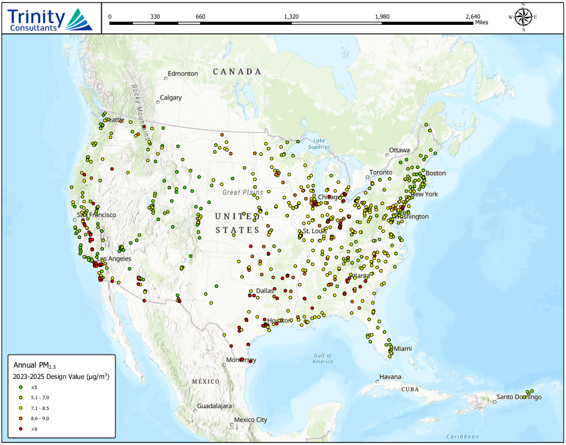
The review identified notable variability in annual PM₂.₅ concentrations between design value periods. Specifically, 27 monitoring sites changed from meeting the revised 9.0 µg/m³ annual standard to exceeding the standard, while 25 monitoring sites changed from exceeding the standard to meeting the standard. These changes demonstrate the challenges associated with PM2.5 designations, as annual concentrations can fluctuate significantly due to changes in emissions, weather patterns, exceptional events, and other factors. While individual monitor results do not independently determine attainment or nonattainment status, these changes provide insight into areas where EPA may conduct additional evaluation as part of the designation process.
Trinity’s review also identified areas with limited remaining margin below the revised PM2.5 standard. Specifically, 32 counties were identified with monitoring sites having design values greater than 8.87 µg/m³ but below the 9.0 µg/m³ standard, representing less than 0.13 µg/m³ of remaining “headroom.” Of these counties, 23 do not currently have another monitor exceeding the NAAQS. While these areas are currently meeting the standard, the limited margin below the NAAQS may create additional considerations for future permitting projects requiring PM2.5 air quality analyses or dispersion modeling, as demonstrating a compliant modeling scenario would be challenging.
The map below shows the annual PM2.5 2023–2025 design value compared to the current threshold of 9 µg/m³.
The upcoming designation process will also be important because PM2.5 is a pollutant for which air quality modeling and permitting analyses can be particularly challenging. Unlike some pollutants, where emissions changes may have a more direct relationship with ambient concentrations, PM₂.₅ levels can be influenced by a variety of sources and atmospheric conditions, including direct particulate emissions and precursor pollutants that contribute to secondary PM₂.₅ formation. As a result, facilities located near areas with limited air quality margin may need to carefully evaluate project impacts, emission increases, and available control strategies when planning future modifications.
For industrial facilities, the key takeaway is that PM2.5 will continue to be an area of increased regulatory focus as EPA proceeds with implementation of the 2024 standard. Facilities considering new construction projects, modifications, expansions, or permit renewals should monitor future designation decisions and evaluate potential PM₂.₅ implications early in the planning process. Trinity will continue tracking EPA’s implementation activities, updated monitoring data, potential exceptional events, and potential permitting impacts associated with the revised PM₂.₅ NAAQS.
Trinity Consultants has extensive experience assisting facilities with PM2.5 regulatory evaluations, air modeling, and permitting strategy. Our team has supported clients with PM2.5 NAAQS analyses, Prevention of Significant Deterioration (PSD) and Nonattainment New Source Review (NNSR) permitting, dispersion modeling, and evaluation of evolving air quality standards. As EPA continues implementation of the 2024 PM2.5 NAAQS, Trinity will continue monitoring regulatory developments and helping facilities understand potential impacts to existing operations, planned projects, and long-term permitting strategies.
Office expertise:
If your facility is planning a new project, evaluating potential modifications, or assessing permit renewal needs, early review and planning can help identify PM2.5 air quality impacts and regulatory considerations before they affect project schedules.
For assistance with PM₂.₅ NAAQS evaluations, air quality modeling, permitting strategy, or project-specific questions, please contact Jacob Harrington with Trinity’s Kansas City office or Jeremias Szust with Trinity’s St. Louis office to discuss how we can support your air quality compliance needs.


