The Wyoming Department of Environmental Quality, Air Quality Division (Division) has changed the minor source operating permit application process. In the past companies could simply submit a short letter requesting an operating permit. The Division now requires companies to submit a formal application that includes a description of how the facility is complying with each condition of their construction permit. These changes will apply to all minor sources except for oil and gas production sites. The minor source operating permit application must be submitted no later than 120 days after startup of the emission sources, or startup of a modification to existing emission sources, authorized by a construction permit.
The History of Wyoming Minor Source Operating Permits
The permitting chapter in Wyoming Air Quality Standards and Regulations (WAQSR) states:
“Facilities or sources not subject to the provisions of Chapter 6, Section 3 of these regulations shall obtain a Chapter 6, Section 2 operating permit from the Department, pursuant to this section, for operation after a 120-day start-up period.” (WAQSR Ch 6 Sec 2(a)(iii))
When the original version of this language was written, many federal New Source Performance Standards were not yet developed. The Division sometimes did not have adequate information to establish emissions limits in the preconstruction permit for a project. As a result, the preconstruction permit often included initial performance test requirements without necessarily including final emission limitations. The test results and as-built information would be used to establish operating limits and ongoing testing/monitoring requirements, which would be incorporated into an operating permit. The operating permit established on-going operating requirements and often replaced the preconstruction permit requirements.
As the Division gained more knowledge about emission sources and how to control emissions, limits and ongoing monitoring and testing requirements were often included in the preconstruction permit; the need for a Section 2 operating permit to establish appropriate limits and define compliance assurance requirements was less compelling. Over time, in practice, Section 2 (minor source) operating permits were issued only when a Title V facility reduced potential emissions to minor source levels and transitioned to minor source status. In this situation, the Section 2 operating permit was often used as a “synthetic minor” permit to ensure enforceability for the reduced emission levels and set conditions to ensure compliance with the new limits.
Despite the Division’s practice not to issue minor source operating permits in most situations, the language in Section 2 operating permits has remained unchanged. Revising regulations is a resource-intensive process that includes a lengthy public and EPA notice and comment period, and agency staffing is limited.
All facilities are required to request an operating permit in accordance with Chapter 6, Section 2(a)(iii) of the WAQSR after start-up, but until now, this requirement was met through a letter, submitted to the Division, requesting a Section 2 operating permit.
What Are the New Expectations for Obtaining an Operating Permit?
All facilities, other than oil and gas production sites, are now required to prepare a more substantial application for an operating permit. Facilities subject to Section 3 Title V permitting requirements will continue to use that process. However, minor source facilities must now request a Section 2 minor source operating permit within 120 days of startup for those sources authorized in the construction permit. The operating permit application must include a description of how the facility is complying with all conditions of the construction permit. From WAQSR Chapter 6, Section 2(e):
“No permit to operate may be granted until the applicant demonstrates to the satisfaction of the Administrator of the Division of Air Quality that:
- The facility is complying with the Wyoming Air Quality Standards and Regulations applicable at the time the permit to construct or modify was granted and with the intent of the Wyoming Environmental Quality Act, 1973.
(ii) The facility has been constructed or modified in accordance with the requirements and conditions contained in the permit to construct or modify.”
To address this requirement, the Division is requesting applicants to list all conditions of the construction permit with detailed information on how the facility adheres to each condition.
The minor source operating permit requirements for oil and gas production sites are not changing. These facilities typically comply with presumptive BACT and submit a permit application post-startup, and thus receive an operating permit without a construction permit.
If the construction permit includes multiple pieces of emitting equipment or operations, and construction and operation is phased in over time, the company may have to submit multiple operating permit applications. Various pieces of equipment can be grouped for these operating permit applications as long as submission is completed within 120 days of startup for all the equipment in that grouping.
Once the operating permit is drafted, it will go on public notice and will be subject to processing fees. The IMPACT system is currently undergoing updates to accommodate the new operating permit process.
Minor Source Operating Permit Application
While paper applications are still allowed, the Wyoming AQD prefers the online IMPACT system for application submittal. Whether an IMPACT or paper application, to facilitate the processing of the permit application, Trinity recommends an application cover letter that includes:
- The IMPACT Facility ID number (it will begin with an “F”);
- The construction permit number (it will begin with a “P”) for the new or modified equipment/operations;
- A request for an operating permit that includes a description of how the facility follows each of the permit conditions in their construction permit; and
- Contact names, emails/phone numbers (These can also be updated within IMPACT rather than included as a permit attachment).
If you use IMPACT, preparing a minor source operating permit application begins by selecting the “Create an NSR Permit Application” button as a new task. This will lead you to a screen that looks like this:
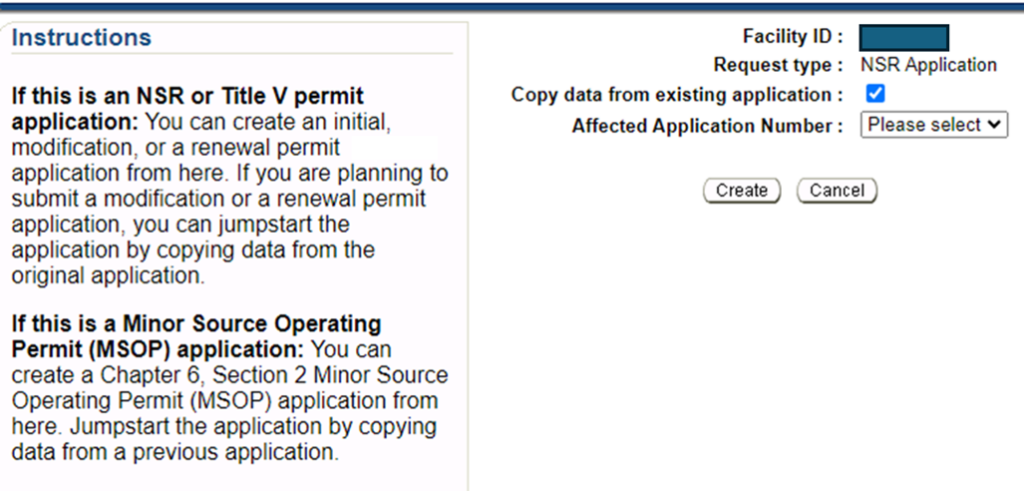
As recommended in the screenshot above, you can jumpstart the process by checking the “copy data from existing application” box and selecting the application number of the construction permit associated with the authorized changes you seek to cover in an operating permit. Once you do this:
- Verify the Facility Contact information is up to date by reviewing the screen shown under “Task – Facility Contact Change”; if not, revise as appropriate.
- Verify the data in the Facility Inventory Change is correct. If it is not, proceed with caution; some changes may require construction permit action and should be discussed with the Division to determine the best path forward.
- Edit the screen under “Task – NSR Application” to indicate the purpose of the application is a request for an operating permit. Remove the cover letter from the copied application and any other attachments not relevant to your request. Verify other information remains correct.
- Upload a cover letter that clearly describes how you are complying with each condition of your construction permit.
The Division is working on additional modifications to IMPACT and will likely release additional guidance over time to assist companies in complying with these new expectations. Trinity has prepared minor source operating permit applications for our Wyoming clients and checks in with Division permitting staff frequently to keep informed on this evolving program. To learn more about the new process for obtaining a minor source operating permit in Wyoming or if you need assistance with your minor source operating permit application, please contact Lori Bocchino of Trinity’s Cheyenne office.


