On November 3rd, 2023, Louisville Metro Air Pollution Control District (LMAPCD) announced that they received the largest grant in Region 4 of $1 million from US EPA Environmental Justice Government-to-Government Program (EJG2G) for a 2024 project titled, “Ambient Air Toxics and Health Action for the Rubbertown Area” to collect ambient air data and connect potential health conditions of west Louisville residents with past and current chemical exposures.
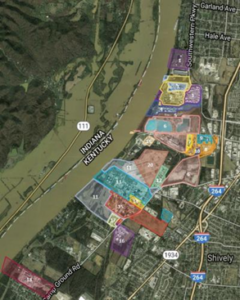
This EJ project plans to examine and address air pollution inequities for residents of west Louisville, notably those specifically around the Rubbertown industrial complex, shown here.
In a November 17, 2023, public webinar, Michelle King, Assistant Director of the LMPACD discussed that the District could be looking to make policy changes based on the results of this EJ grant project.
According to the December 20, 2023, Air Pollution Control Board Meeting, the District is in the position to receive this grant because of the board’s work to have one of the most stringent air toxics programs in the nation (i.e., Louisville’s Strategic Toxic Air Reduction [STAR] Program which began in June 2005).
A Brief History of Toxic Air Pollutant Monitoring in Louisville, Kentucky
Between April 2000 and December 2005, the West Jefferson County Community Task Force (WJCCTF), LMAPCD, US EPA, the Kentucky Division for Air Quality, and the University of Louisville conducted the West Louisville Air Toxics Study (WLATS) in response to community concerns about toxic air pollutant emissions from Rubbertown, which lead LMAPCD to propose the STAR program. Since STAR was implemented in 2005, emissions of toxic air contaminants (TACs) have dropped almost 80 percent in Jefferson County.

What do the 2024 EJ Initiatives and Additional Air Monitoring Mean for Rubbertown?
According to the Assistant Director of the LMAPCD from the November public webinar, the District hopes to begin the air monitoring portion of the EJ project in June 2024. Meanwhile, the Christina Lee Brown Envirome Institute at the University of Louisville (Envirome) will conduct a wastewater sampling study. The Ambient Air Toxics and Health Action for the Rubbertown Area is expected to be a 3-year project collaborating with several local community partners (The University of Louisville, Park DuValle Community Health Centers, and Louisville Metro Public Health and Wellness). The data collected from the study will be used by many of the community partners with a variety of objectives including, but not limited to the following:
- Organize community engagement activities
- Develop policy recommendations based on air monitoring and health risk assessment findings
- Determine community health risks
- Share health equity data and expertise to further inform policy recommendations
- Reveal and communicate environmental health risks
- Address health inequities burdening residents
The WJCCTF intends to work with the DuValle Community Health Center to directly connect environmental health risks to clinicians to use at the point of care and to reveal potential health risks related to chemical exposures.
As a long-time partner with many companies and facilities in the Louisville area, Trinity has experts available to discuss the ramifications of these new initiatives. Please reach out to Bethany Boehl or Maren Seibold at Trinity’s Covington Office for more information.


