This article appears in Japanese in the November 2026 issue of Pharma Japan, a copyrighted publication
Over the past thirty years, the pharmaceutical industry has seen an increase in the potency of new active pharmaceutical ingredients (APIs). This trend has been beneficial for patients as the lower therapeutic dose may increase the margin of safety over adverse effects not related to the pharmacology of the drug. However, since the occupational hazards of handling APIs tend to be proportional to their potency, this has led to the need for special considerations for evaluating worker exposure risk and controlling airborne release of these APIs.
Hazard Assessment of Ultra-Potent Pharmaceuticals
The degree of hazard associated with an API is generally indicated by the occupational exposure limit (OEL); defined as the airborne concentration of a chemical substance that a worker can be safely exposed to for a 40-hour work week, for a working lifetime. It is not unusual for APIs to have OEL values that are below 10 µg/m3, the commonly accepted definition of a potent compound. However, an increasing number of ultra-potent APIs have OEL values in the 1-10 ng/m3 range, and a handful of OEL values have been derived that are less than 1 ng/m3.
The methodology used in deriving these values for APIs was initially published in 1988 by Sargent and Kirk (1988), and has been repeatedly refined by other authors over the years (Galer et al, 1992; Naumann & Sargent, 1997; Dankovic et al, 2015), but the basic premise remains the same:
- Identify the adverse effects of the API from human and/or animal studies.
- Define the lowest dose of the API that causes this effect or the highest dose that does not cause the effect. This is defined as the point of departure (POD).
- Apply adjustment factors to account for variability and uncertainties considered in modifying the POD to a dose believed to be safe for workers repeatedly exposed to the API.
- Divide by the amount of air inhaled during a work shift to express the value as an airborne concentration limit.
The primary variables that drive an APIs overall hazard are its lowest therapeutic dose (an indication of its pharmacological potency) and the severity of the pharmacological and toxicological properties. Ultra-Potent APIs are often associated with anti-neoplastic drugs but may also be associated with peptide hormones and antibody-drug conjugates (ADCs). Although the entire ADC may not be ultra-potent, the warhead (Fig. 1), which has been conjugated to an antibody specific for the tumor type, is typically ultra-potent. ADCs allow this ultra-potent warhead to be delivered directly to the target tumor while avoiding the toxic effects of the warhead that would otherwise not be tolerated by the patient. The use of increasingly high adjustment factors and the resulting low OEL values mostly represents the high degree of uncertainty associated with extrapolating adverse effects seen in the clinic or animal studies to levels believed to be safe in healthy workers.
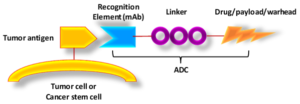
Figure 1: Antibody Drug Conjugate (ADC); the warhead is ultra-potent (courtesy of Bristol Meyers Squibb).
These extremely low OEL values present engineers developing manufacturing equipment with the difficult task of controlling worker exposures to very low airborne limits. At these low limits, the release of invisible amounts of airborne API particles may result in exceedance of the safe limit. In addition, it presents the industrial hygiene chemists with the challenge of developing analytical methods capable of detecting extremely low limits of quantification (LOQs).
Evaluating Occupational Exposure risk
Whether the pharmaceutical manufacturing process is new or existing, a systematic approach for evaluating associated occupational exposure risk is recommended. A systematic strategy like that recommended by the AIHA is commonly used by the pharmaceutical industry (Jahn et al, 2015). Risk assessments are organized as:
Identify Hazards – Assigning a relative degree of hazard is often the initial step. The tool used routinely within the pharmaceutical industry is the Occupational Exposure Band (OEB) or OEL which evaluates the overall hazard and potency of the API and expresses it in a qualitative or quantitative way, respectively (Naumann & Sargent, 1997; Sargent & Kirk, 1988).
Establish Similar Exposure Groups (SEG) – A similar exposure group is defined as “a group of workers having the same general exposure profile for a hazardous agent based on the similarity of materials, frequency, processes, and ways they perform their tasks”.
Qualitative Exposure Assessment – Each SEG can be prioritized following a qualitative risk assessment framework that evaluates risk of exposure based on a defined set of criteria such as quantity of the hazardous API, its frequency and duration of use, the task or activity being performed, and any existing controls. The level of hazard is combined with these factors to tabulate an exposure risk score that can be used to prioritize actions, including support for a decision to collect quantitative exposure monitoring data.
Quantitative Exposure Assessments – Once tasks and associated exposure risks are prioritized, it is necessary to measure workplace exposures to verify risk assumptions and to confirm that exposure control devices, work practices, and personal protective equipment sufficiently protect workers below defined exposure control limits. Quantitative exposure assessments occur following a multi-step process including 1) engineering control device containment performance assessments, 2) initial exposure risk assessments, and 3) ongoing exposure reassessments.
Containment of Ultra-Potent Pharmaceuticals
The classic hierarchy of control drives the use of engineered containment systems for the safe handling of all potent, highly potent and ultra-potent APIs in the pharmaceutical industry (Fig. 2). Elimination or substitution of the API in development are obviously not available solutions. Containment using engineering controls aims to reduce the risk of worker exposure to the API handled during product manufacture to an acceptable level, typically to an airborne concentration below the OEL. The challenge with ultra-potent APIs is that the OEL may be exquisitely small, equivalent to low numbers of airborne particles of API per cubic meter. The physical methods commonly used to support use of a system in normal operation (measured pressure drops, visual inspection, etc.) are not adequately sensitive to allow the identification of failure of containment and release of API; therefore, proactive and ongoing containment performance testing using extremely sensitive sampling and analytical methods are required.
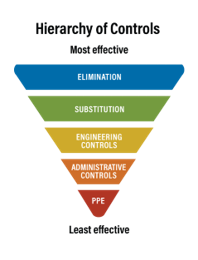
Figure 2: Hierarchy of Controls (CCOHS “Hazard and Risk – Hierarchy of Controls” https://www.ccohs.ca/oshanswers/hsprograms/hazard/hierarchy_controls.html)
All the above leads to the application of a precautionary approach for handling these materials including the application of conservative equipment selection, with secondary protection against the unidentified failure of the primary systems. Typically, robust barrier systems such as isolators (rigid or flexible) are used, commonly with negative pressure HEPA-filtered ventilation to avoid inadvertent pressurisation. Performing operations inside a closed isolator allows for limited opportunity for API release. There is a greater opportunity for release to the work environment as ingredients and other materials are brought into the isolator and as finished products are brought out of containment. The entry and exit points are typically designed using contained transfer devices, such as bag-in/bag-out sleeves, split butterfly valves, or rapid transfer ports. Ancillary activities such as cleaning and maintenance (e.g. filter change) also need to be carefully considered, and appropriate controls designed for a coherent design. Open-faced extract-based systems such as fume hoods and downflow booths allow for more potential user-related failure modes (inadvertent blockage or disturbance of air flows, personal gowning/hand contamination, etc.) and so are not recommended as primary controls when working with ultra-potent compounds. Further to this, the use of precautionary personal protective equipment by users and the use of airlocked process rooms with suitable pressure cascades, exhaust filtration and personal decontamination facilities on personnel exits, should be considered to limit the release of any API.
Verifying Containment When Handling Ultra-Potent Pharmaceuticals
Containment systems, such as those discussed above, that “control exposures at the source”, can be designed to be a highly effective solution for the safe handling of ultra-potent APIs. Such systems are designed to be robust and capable of providing a safe work environment. However, poor operator training and/or behavior can cause well designed systems to fail. The key challenges when operating these devices are the mechanisms for transferring materials into and out of the containment system and the procedures and training associated with operating the device. The effectiveness of containment systems should not be assumed; they must be verified according to industry norms to demonstrate that the required containment performance has been achieved. Containment verification is carried out using a surrogate material to challenge the device during normal usage while measuring airborne surrogate around the containment that may be escaping from the device (ISPE, 2024). The surrogate should be a low toxicity, easily cleanable substitute for the API. Testing the performance of the isolator or other containment device using a low toxicity compound prior to running the operation with a highly hazardous, ultra-potent material is a sensible precaution before clearing the device for production.
Analytical Sensitivity is Not the Only Challenge
As mentioned above, increasing API potency generally leads to decreases in OEL values, increasing the challenge of verifying the effectiveness of containment systems. An analytical method is available from commercial laboratories with an LOQ of 5 picograms/sample for the common surrogate, naproxen sodium. The preferred LOQ for an industrial hygiene analytical method is one where 10% of the OEL can be measured while sampling for 15 minutes at 2 Liters per minute. An LOQ this low allows us to determine an airborne surrogate concentration as low as 1.7 ng/m3. However, these extremely low concentrations can translate to very few particles in a cubic meter of air. So, when verifying containment, the LOQ is not the only challenge. It is also important to be able to capture enough airborne particles that may escape containment. The normal first response in this case is to turn to the analytical laboratory to increase analytical method sensitivity. While method sensitivity is important, it is not currently the only limiting factor.
A reduction in the airborne particle concentration significantly affects the ability to sample for API or surrogate. For a potent API (OEL = 10 µg/m3) there is reasonable confidence that the results of airborne sampling represent the actual concentration of API present. However, for an ultra-potent API (OEL = 1 ng/m3), the more likely outcome is that no airborne particles are collected or, if they are collected, then the airborne concentration may be overestimated.
Potential Solutions
Increase the volume sampled by sampling for longer periods of time or reduce the particle size of the airborne material.
The volume sampled can be increased by raising the flowrate of the pump or sampling for a longer time. Increasing the flowrate may affect the particle size selection of the sampling device as well as increasing the associated sampling pump back pressure. This solution has both practical limitations and limitations with respect to the extent that it will increase the chances of capturing ultra-potent particles.
An alternative solution is to increase the number of airborne particles by using a surrogate with a lower particle size. For example, if a micronized surrogate with average particle size of 1 µm is used, there will be approximately 50 airborne particles present per a 40 L sample at a concentration of 1 ng/m3. This is an effective solution to overcoming the low probability of collecting enough particles. Although smaller surrogate particle size may not be representative of API powders seen during production, it will be suitable for verifying containment performance. This approach is recommended for ultra-potent containment system evaluation.
Summary
The safe handling of ultra-potent APIs presents challenges but does not fundamentally change the normal approach applied by the toxicologist, containment engineer, or industrial hygienist. However, if effective containment solutions are applied, resulting in a reduction of the number of airborne surrogate particles outside of the control device, then there are significant limitations imposed when verifying the performance of the containment device. Effective solutions are to increase sampling volume by adjusting flow rate and/or time, and to reduce the particle size of the surrogate to increase the number of airborne surrogate particles in the environment. Confidence in the performance of a containment device is achieved through the systematic qualitative and quantitative risk assessment, and at-source exposure control, with routine re-testing / monitoring to detect changes in performance over time which may occur due to physical change, process change, maintenance changes, work practice and training changes.
References
Dankovic DA et al. (2015) The Scientific Basis of Uncertainty Factors Used in Setting Occupational Exposure Limits. Journal of occupational and environmental hygiene 12 Suppl 1: S55-68. DOI: 10.1080/15459624.2015.1060325
Galer DM et al. (1992) Scientific and practical considerations for the development of occupational exposure limits (OELs) for chemical substances. Regul Toxicol Pharmacol 15(3): 291-306. DOI: 10.1016/0273-2300(92)90040-g
ISPE Good Practice Guide: SMEPAC Standardized Methodology for the Evaluation of Pharmaceutical Airborne Particle Emissions from Containment Systems.
Jahn SD et al. (2015) A Strategy for Assessing and Managing Occupational Exposures, 4th Edition. AIHA Press https://www.aiha.org/education/marketplace/strategy-book-4th-edition.
Naumann BD & Sargent EV (1997) Setting occupational exposure limits for pharmaceuticals. Occupational medicine (Philadelphia, Pa) 12(1): 67-80. https://pubmed.ncbi.nlm.nih.gov/9153053/
Sargent EV & Kirk GD (1988) Establishing airborne exposure control limits in the pharmaceutical industry. Am Ind Hyg Assoc J 49(6): 309-313. DOI: 10.1080/15298668891379792
If you have any questions or need assistance with environmental due diligence or permitting for data centers, please contact Jennifer McCrohan or Mike Burr at the Seattle office or call 775.242.3400.


