On September 19, 2025, Governor Newsom signed into law Senate Bill 840 and AB 1207, which extended the AB 32 Cap-and-Invest Program through 2045 among other key regulatory amendments. Based on this legislation, the California Air Resources Board (CARB) is providing further amendments to the AB 32 regulations to reflect the direction and process in AB 1207. On July 14, 2026, CARB submitted its final rulemaking documents for amendments to the AB 32 Cap-and-Invest Regulation (formerly Cap-and-Trade Regulation), which include several key changes.
Regulatory Background
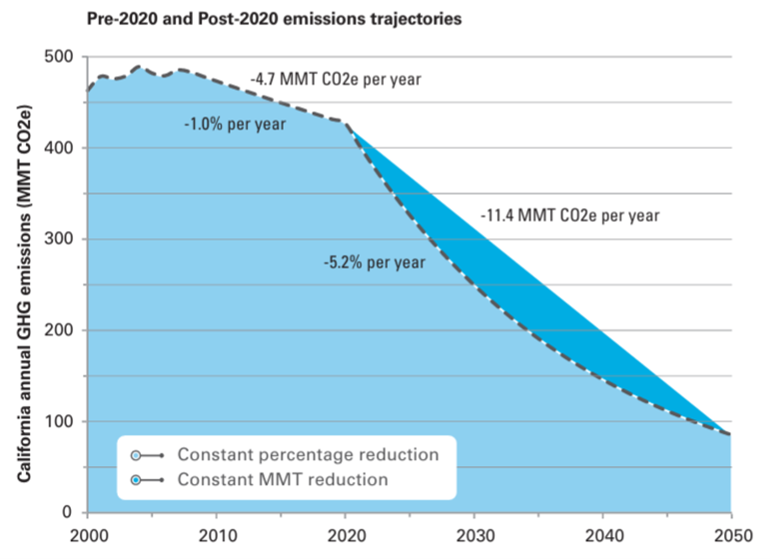
California’s long-term climate objective is to reduce statewide anthropogenic GHG emissions by 85% by 2045. To achieve this goal, AB 32 regulations are projected to reduce statewide GHG emissions below 100 million metric tons of carbon dioxide equivalent (MMT-CO2e) by 2045, as shown below. As a major component of AB 32, CARB adopted the Cap-and-Invest Program in October 2011, establishing a declining annual emissions cap for regulated major sources of greenhouse gas (GHG) emissions throughout California. The Cap-and-Invest program was initially adopted through calendar year 2020, which was subsequently extended through 2031. The recent amendments further extend this regulatory program through 2045.
The Cap-and-Invest Program applies to major sources of greenhouse gas (GHG) emissions that emit more than 25,000 MT-CO2e annually. Covered entities primarily include industrial facilities, fuel distributors, electric utilities, and power plants. Subject facilities are required to report their GHG emissions annually and comply with applicable annual emissions limits established under the program. Facilities that exceed their annual emissions limits must obtain additional compliance instruments, either through California Carbon Allowances (CCAs) that may be purchased at CARB’s quarterly auctions or through private sellers, or through eligible California Carbon Offsets (CCOs) acquired from private sellers. Since the program’s implementation in 2013, CARB’s quarterly CCA auctions have generated more than approximately $54 billion in statewide revenue through calendar year 2025, averaging roughly $4 billion annually.
Manufacturing Decarbonization Incentive Fund (MDIF)
One of the most significant amendments to the AB 32 Cap-and-Invest Program is the creation of the Manufacturing Decarbonization Incentive Fund (MDIF), which CARB describes as the first incentive program of its kind for a cap-and-trade system. The MDIF is intended to provide up to $4 billion in financial assistance to regulated facilities that continue operating in California while accelerating greenhouse gas (GHG) emission reductions at eligible facilities. Eligible participants include entities subject to the Cap-and-Invest Program, such as cement manufacturers, steel producers, food processors, and other industrial facilities. CARB will initially fund the MDIF through a dedicated reserve account that will include up to 118 million CCAs that will be set aside and withheld from future auctions. Instead of being auctioned, these CCAs will be awarded as financial incentives for approved projects. Recipients may either sell the CCAs at prevailing market prices to help finance project costs, or use them to meet their annual compliance obligations under the Cap-and-Invest Program. MDIF funding will be available only for qualifying GHG emission reduction projects, such as the replacement of fossil fuel-powered equipment with lower-emission technologies, deployment of low-carbon hydrogen, renewable energy generation, carbon capture and sequestration, methane emission reduction projects or others. The first MDIF applications are due by June 1, 2027, and incentive allowances awarded through the program will first be eligible for use in calendar year 2028.
Other Key Amendments
Adjusted Annual Emissions Cap – As discussed above, the AB 32 Cap-and-Invest Program has been extended for calendar year 2032 through 2045. As part of this extension, CARB revised the program’s annual emissions budget (annual cap) to reflect increasingly lower statewide GHG emissions over the extended 14-year period. Under the amended regulation, the annual emissions cap is set at 136.8 million MMT-CO2e in calendar year 2032, which declines each year to a final cap of 30.3 MMT-CO2e in calendar year 2045. This represents an approximately 77% reduction in the annual emissions cap during the extended compliance period from 2032 through 2045.
Electrical Distribution Utility (EDU) Allocation – In response to stakeholder and legislator concerns about electricity affordability due to reduced EDU allowance allocation, the recent amendments have increased allowance allocation to most EDUs for 2027-2030 by updating the allocation methodology to reflect the effective carbon cost burden associated with Renewables Portfolio Standard (RPS) Program compliance.
Industrial Allocation for Leakage Protection – The recent amendments removed the initial proposal for Cap Adjustment Factors (CAFs) for industrial allocation after 2030, providing CARB with additional time to analyze data on emissions leakage risk and propose updated industrial allocation and any other complementary leakage protection measures post-2030 in a future rulemaking.
Natural Gas Supplier (NGS) to EDU Allocation Transition – AB 1207 directs CARB to transition allowances provided to investor-owned natural gas suppliers to all EDUs (both investor-owned and publicly owned) by January 1, 2031. The recent amendments require a 70% transition by 2031, with the remaining 30% of investor-owned gas utility allowances reserved for the benefit of low-income ratepayers to be directed by the California Public Utilities Commission (CPUC). The transition of allowances that will occur post-2030 will be reassessed in a future rulemaking.
Shared Role Exemption/Disclosure – In response to stakeholder concerns regarding compliance costs and the administrative burden associated with the Shared Role Exemption application process, CARB has made certain key changes. Under the amended regulation, a covered entity or opt-in covered entity is not required to disclose a direct corporate association resulting solely from an individual Cap-and-Invest consultant or advisor serving multiple covered entities, provided that the individual performs services exclusively for covered entities and does not maintain a user account in the tracking system. In these circumstances, no Shared Role Exemption application is required.
Carbon Offset Projects – CARB proposed changes to clarify and streamline listing, reporting, and verification requirements for offset projects. The newly required report for a change in sequestration offset project ownership is now within 60 days of the ownership transfer instead of prior to the transfer. In addition, CARB has specified an extended timeline for project developers and verifiers to resolve outstanding issues as part of a verifiable offset project data report petition for projects already in verification.
What’s Next for California’s Cap-and-Invest Program
These most recent amendments to the AB 32 Cap-and-Invest Program establish some of the most ambitious statewide GHG emission reduction targets in the United States and globally. By calendar year 2045, CARB requires major industrial sources of GHG emissions to comply with a final annual emissions cap of 30.3 MMT-CO2e. Compared to the initial annual cap of approximately 395 MMT-CO2e in 2015, this represents an overall reduction of approximately 92% over the life of the program. Notably, these recent regulatory amendments forecast a decline of 77% in the annual emissions cap that will occur during the extended compliance period from 2032 through 2045. Recognizing that these accelerated reduction targets could have significant economic impacts on California industries, CARB has established its new MDIF with an estimated $4 billion of available funding to help finance GHG emission reduction projects at eligible facilities. However, the effectiveness of the MDIF will ultimately depend on broad participation by eligible facilities and whether it successfully incentivizes the implementation of GHG emission reduction projects necessary to achieve California’s aggressive climate goals.
Trinity Services
Trinity can help industries comply with California’s AB 32 Cap-and-Invest program by providing comprehensive regulatory and technical support, including:
- Regulatory Tracking & Interpretation
- Emissions & Allowance Strategy
- Data Management & Verification Readiness
- Stakeholder Engagement Support
- GHG Reduction & Offset Opportunities
- Strategic & ESG Integration
For more information on the AB 32 Cap-and-Invest program or Trinity’s sustainability consulting services, please reach out to Steve Walters or Charles Lee from Trinity’s Irvine office at 949.567.9880.


