The Colorado Department of Public Health and Environment (CDPHE) adopted the final greenhouse gas intensity verification rule in July 2023.
The Regulation 7 revisions include requirements on how upstream oil and gas facilities calculate greenhouse gas (GHG) intensity and monitoring/recordkeeping requirements for upstream oil and gas operators. These requirements are part of a Colorado’s larger effort to reduce emissions through the Greenhouse Gas Roadmap and to address the critical issue of climate change. The revisions include updates to Part B, Sections II, V, and VIII of Regulation 7. These revisions are applicable to all operators subject to the Oil and Natural Gas Air Emissions Inventory Report (ONGAEIR) (i.e.; all operators with equipment at or upstream of a natural gas processing plant and operators of class II disposal facilities).
Note that prior to the reorganization of Regulation 7 in June 2023, these updates were originally proposed to be included in Regulation 22. However, Regulation 22, Part B, Section III and IV were moved to Regulation 7, Part B, Section VII and VIII with the June 2023 version of the rule.
GHG Intensity Targets
The GHG intensity targets remain unchanged since they were adopted in December 2021 and are summarized in the table below. GHG intensity in Regulation 7 is defined as total annual GHG emissions in metric tons of carbon dioxide equivalent (CO2e, as calculated using AR5 global warming potentials) divided by total annual production in thousand barrels of oil equivalent (kBOE, calculated pursuant to Section VIII.D).
An intensity operator that fails to achieve any of the applicable targets must achieve additional reductions in preproduction and/or production emissions in the subsequent calendar year. Beginning June 30, 2026, if an intensity operator does not meet the required intensity target for the previous calendar year, the operator must revise or supplement their GHG intensity plan to demonstrate how they will meet the targets and achieve the additional required reductions.
Regulation 7, Part B, Section VIII GHG Intensity Targets for the Upstream Segment (mtCOe/kBOE)
| Applicable Calendar Year for Intensity Target | Company-wide Preproduction and Production Emissions | New Facilities (commence operation after December 31, 2022) |
| Majority Operator | Minority Operator | Located in the 8-hour Ozone Control Area and in a DI community | Remainder of Colorado |
| 2023 | | | 7.7 | 8.59 |
| 2024 | | | 7.7 | 8.59 |
| 2025 | 10.94 | 34.39 | 7.7 | 8.59 |
| 2026 | 10.94 | 34.39 | 6.0 | 6.64 |
| 2027 | 8.46 | 26.60 | 6.0 | 6.64 |
| 2028 | 8.46 | 26.60 | 4.8 | 5.34 |
| 2029 | 8.46 | 26.60 | 4.8 | 5.34 |
| 2030 | 8.46 | 21.38 | 4.8 | 5.34 |
The Regulation 7 revisions focus on the GHG Intensity Verification Calculation Methodology at the company-wide level (across all basins and facilities statewide) and for new facilities (well production facilities that commence operation after December 31, 2022). The goal of the verification program is to improve the bottom-up inventories, to account for previously unreported emissions through measurement-informed verification, and to utilize developing programs such as United Nations Environment Programme Oil and Gas Methane Partnership 2.0 (UNEP OGMP 2.0), GTI Veritas, and MiQ.
GHG Intensity Targets
A key component of the Regulation 7 revisions is the idea of having a “measurement-informed inventory.” The Division points to recent studies that suggest that GHG inventories underestimate the oil and gas sector’s contribution to methane emissions and that a significant portion of the discrepancy exists because current inventory methods miss emissions that occur during abnormal operating conditions.
The Division has defined a measurement-informed inventory as one that is informed by direct measurements of GHG emissions from regional, local, stationary source, or air pollution source monitoring of methane emissions, and, optionally, through parametric monitoring. Parametric monitoring is defined as regional, local, stationary source, or air pollution source monitoring of pressure, temperature, flow rate, control efficiency, or other operational characteristics. A measurement-informed inventory will consist of the ONGAEIR for preproduction and production emissions informed by measurements of emissions.
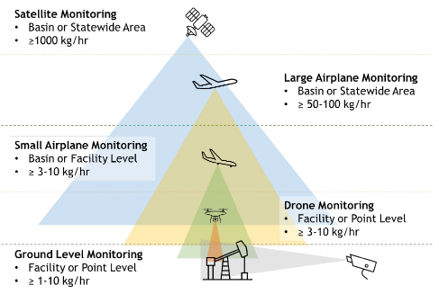
For calendar years 2023 and 2024, operators of new facilities will use their ONGAEIR to calculate intensity to compare against standards. Beginning with calendar year 2025, operators must use a measurement-informed annual emissions inventory in calculating annual company-wide GHG intensity. A measurement-informed inventory is achieved by either applying a state default intensity factor or alternatively using a Division-approved program. In May 2024, the Air Pollution Control Division published the oil and natural gas methane intensity verification protocol, which defines how the Division will generate the state-wide methane verification factor and outlines how the Division will iteratively improve the factor. The protocol also provides alternative options for operators to follow to validate their state-wide methane emissions and intensities reported to CDPHE.
Starting in 2024, the Division will annually publish one or more state default intensity verification factor(s). This is the methane factor developed to account for the difference in measured methane emissions and reported methane emissions and used in the calculation of GHG intensity. The 2025 ONGAEIR production and pre-production workbooks due June 30, 2026 are subject to the 2025 state default intensity verification factor of 1.164. The 2026 state default intensity verification factors are different for three “intensity regions” and range from 2.2-2.7.
An alternative to the state default, an operator-specific and Division-approved program must include a measuring strategy (periodic measurements of actual emissions and/or parametric monitoring), a third-party audit of GHG emission inventory for calendar years 2025, 2027, and 2030, and any other requirements identified by the Division. Operators must use a measurement strategy developed by the Division in 2025 and 2026 and a list of approved measurement strategies will be published in the Intensity Verification Protocol. Beginning in 2027, operators may develop their own measurement strategies, subject to Division approval. All measurement strategies must be reviewed annually and updated as necessary.
The GHG intensity verification rule includes several overlapping reporting timelines:
- By June 30, 2024 (and annually through 2031) operators must submit annual verifications for the previous calendar year (Reg 7, Part B, Section VIII.G.2.);
- By September 30, 2024 (and annually through 2029) operators must notify the Division of their intent to use an operator-specific GHG intensity verification program for the following calendar year and if so, submit to the Division a summary of the measurement strategy (Reg 7, Part B, Section VIII.G.1.);
- By December 31, 2024 (and annually through 2029) the Division will publish one or more state-default intensity verification factors valid for the following calendar year (Reg 7, Part B, Section VIII.F.3.a.);
- By March 31, 2026 (and annually thereafter), operators using an operator-specific GHG intensity verification program and opting to use operator-specific measurement strategies must submit their strategy to the Division for review and approval for the following calendar year (Reg 7, Part B, Section VIII.F.3.b.(i)(A)(2));
- By June 30, 2026 (and annually through 2031) operators using an operator-specific GHG intensity verification program must submit the measurement strategy and an evaluation of the implementation of the measurement strategy for the previous calendar year to the Division (Reg 7, Part B, Section VIII.G.4);
- Third-party audit reports for operator-specific programs are due by December 31, 2026, December 31, 2028, and December 31, 2031 for the previous calendar year (Reg 7, Part B, Section VIII.F.3.b.(ii) and VIII.G.5).
Third-Party Audit and Intensity Verification Protocol
The auditing of the selected inventory years and monitoring strategy must be conducted by a certified third-party auditor. The Division includes the following as requirements for a certified third-party auditor:
- Must have no financial incentive to the operator;
- Must have expertise in the areas of emission calculation, monitoring, and measurement technologies;
- Must be certified to perform such audits, as determined by the Division;
- Must not have been affiliated with the annual emission inventory calculations, permitting, or compliance support for that operator being audited.
Regulation 7 and the Verification Protocol document include robust auditing provisions. The certified third-party auditor must ensure that all emissions and calculated intensity reported to ONGAEIR are accurate within a reasonable percentage. The auditor must provide a summarized report by December 31 of the following calendar year with a list of any findings that may indicate the GHG inventory needs to be adjusted, along with any revisions the operator is making to address those findings. The audit must include review of all GHG emission calculations reported in ONGAEIR, emission monitoring records collected under the monitoring strategy, and records maintained in support of monitoring, testing, and reporting requirements of Regulation 7 that affect the operator’s GHG inventory.
Widely Applicable Regulation 7 Updates to Section II.B. and V.
Other updates to Regulation 7 are applicable to all operators subject to ONGAEIR requirements (i.e. all operators with equipment at or upstream of a natural gas processing plant and operators of class II disposal facilities).
Part B, Section II.B. has been updated to include a pressure actuator system as an alternative to flow meters for monitoring enclosed combustion devices (ECDs). As of May 1, 2023, all ECDs used to comply with Section II are required to have either flow meters or pressure actuator systems. A pressure actuator system monitors and records pressure and automatically actuates a valve to open and close at pressure setpoints selected by the owner.
The revised Regulation 7 includes revisions to the ONGAEIR reporting requirements under Part B, Section V. The inventory for calendar year 2022 was the last to require justification and supporting documentation for using emission calculation methods that do not align with the Greenhouse Gas Reporting Program. Starting with the report for calendar year 2024, individual monthly emissions must be reported (as opposed to annual emissions and monthly emissions only for summer ozone months) and centrifugal compressor leaks or vents must be aggregated per compressor (rather than per facility).
The revised rule expands the requirement to verify site-specific emission factors every 5 years to explicitly include those developed via pressurized liquid sampling or another Division-accepted analytical method (previously the rule only referred to gas speciation analysis). Finally, Section V includes updated annual reporting requirements to support GHG intensity verification and reporting.
If you would like to discuss the GHG intensity verification rule and how these changes may impact your operations, please contact Trinity’s Denver office or call 720.638.7647. For more information on Trinity’s auditing and verification services, visit our website.


