The final rule to require a Facility Response Plan (FRP) for certain facilities storing Clean Water Act (CWA) hazardous substances (as listed under 40 CFR 117) was posted to the Federal Register March 28, 2024. The FRP is required to address a worst-case discharge of CWA hazardous materials. A worst-case discharge is defined as the largest foreseeable discharge in adverse weather conditions, which includes extreme weather conditions due to climate change.
Facilities that are subject to the rule are required to prepare response plans in the event of worst-case discharges, or threat of such discharges, and submit them to EPA by June 1, 2027 (for covered facilities in operation by November 30, 2026). The FRP must be submitted within 6 months for newly regulated covered facilities after November 30, 2026. Plans must be submitted prior to operations and include a 60-day start up period for newly constructed covered facilities starting operations after June 1, 2027.
Some highlights from the final rule:
- The threshold for triggering a CWA FRP is 1,000x the Reportable Quantity (RQ) listed in 40 CFR 117.3. For example, ammonia has a RQ of 100 lbs, so the FRP threshold would be 100,000 lbs). If a hazardous substance storage quantity threshold is exceeded, additional criteria must be met to determine applicability:
- The facility is within 0.5-miles of navigable water or a conveyance to navigable water; and
- The facility meets one or more of the following substantial harm criteria:
- Has the ability to cause injury to fish, wildlife and sensitive environments.
- Has the ability to adversely impact a public water system.
- Has the ability to cause injury to public receptors.
- Has had a reportable discharge of a CWA hazardous substance above the RQ within the last five years that reached navigable water.
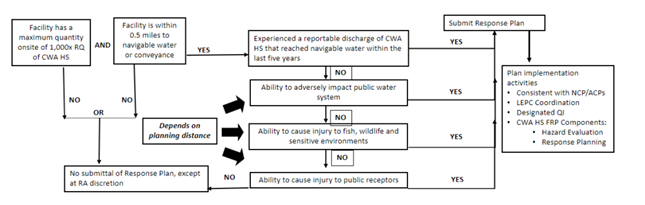
- The 1,000x RQ threshold is based on the aggregate “maximum quantity onsite” – similar to Tier II applicability. This is different than the proposed “maximum capacity onsite” which was similar to what is used to determine the Spill Prevention, Control, and Countermeasure (SPCC) applicability. A facility subject to the CWA FRP regulations must also plan for future anticipated substance(s) onsite since FRP threshold quantities are based on the maximum quantity at any one time for each CWA hazardous substance.
- The rule accounts for mixtures differently than the SPCC provisions.
- If the quantity of all CWA hazardous substance constituent(s) of the mixture or solution is known, the mixture meets the threshold quantity when the maximum quantity onsite, meets or exceeds the threshold quantity of any CWA hazardous substance in the mixture by extrapolating the amount of each constituent to the full capacity of the container.
- If the quantity of one or more of the CWA hazardous substance constituents(s) of the mixture or solution is unknown, the mixture meets the threshold when the maximum capacity onsite of the mixture or solution meets or exceeds the lowest threshold quantity for the CWA hazardous substance extrapolating the amount of the known constituent(s) to the full capacity of the container.
- The rule emphasizes considering climate change with the worst-case discharge scenarios. The EPA rule includes undefined and ambiguous terms such as “climate impacts” and “adverse weather”. EPA’s purpose for vague terminology is to capture the wide range of changes and conditions due to the differing regional weather patterns as prescribing specific types of events or adverse weather conditions is unrealistic and does not represent the various challenges encountered due to climate change.
- EPA provides examples such as: increased frequency and intensity of extreme weather events, temperature fluctuations, rising seas, storm surges, inland and coastal flooding, drought, wildfires, and permafrost melt in northern areas.
- The EPA did not include provisions regarding passive mitigation, administrative controls, or secondary containment requirements since this is a planning regulation. These are not incorporated into the screening criteria, determinations of substantial harm, nor in the FRP hazard evaluation.
- Similar to an oil FRP, the CWA FRP rule requires facilities to calculate a planning distance and complete a hazard evaluation of sensitive environments and receptors along the discharge pathway. To calculate a planning distance, EPA allows for facilities to employ their own models for determining planning distance, while also noting the complications involved: The Agency is aware of the complexity and cost of modeling endpoints for all CWA hazardous substances above the threshold, examining communities with environmental justice concerns, and considering climate change impacts in hazard evaluations. EPA intends to provide tools and compliance assistance to help the regulated community comply with these requirements and maintains that their inclusion is critical to protect the environment in the event of a worst-case discharge. Facilities must determine whether to start now with their own methodology or risk waiting for EPA’s guidance. Regardless of your choice, EPA requires covered facility owners or operators to provide EPA access to models, submit documentation substantiating the methodology, and describe the features to local emergency planners if they are used in the evaluation.
- The contents of the CWA FRP are similar to the existing oil FRP requirements, including, but not limited to, the following:
- Facility Information
- Hazard Evaluation
- Chemical-specific information, including the response considerations, health hazards, fire hazards, chemical reactivity, hazard classifications, and physical and chemical properties
- Potential effects of a CWA hazardous substance worst case discharge as per 118.10
- Impacts to communities with environmental justice concerns
- Impacts of climate change, including but not limited to the increased frequency and intensity of extreme weather events, temperature fluctuations, rising seas, storm surges, inland and coastal flooding, drought, wildfires, and permafrost melt in northern areas
- Illustrative diagrams of the hazard evaluation
- Risk Identification, Characterization, Control, and Communication
- Response Personnel and Equipment
- Contracts with External Spill Response Resources
- Notification Procedures
- Evacuation Procedures
- Discharge Detection Systems
- Disposal Plans
- Emergency Response Action Plan
- Here are some common 40 CFR 117 hazardous substances, their RQs, and their FRP thresholds. Note that oils subject to 40 CFR 112 requirements are exempt from this new regulation.


