Did you have a refrigerant-containing appliance that was a “problem child” in 2026?
Appliances which required repeated refrigerant additions in 2026 may be subject to the chronic leaker reporting requirements in 2027.
The requirement to report chronically leaking appliances has only applied to ozone depleting substances (ODS)-containing appliances with 50+ lb charges since 2019. Beginning with the 2026 calendar year, owners and operators must also report for appliances containing full charges of 15+ lb of hydrofluorocarbon (HFC) refrigerants, or listed substitutes with global warming potential (GWP) greater than 53, if the appliance leaks 125% or more of its full charge during the calendar year. The first reports under this requirement are due to EPA by March 1, 2027.
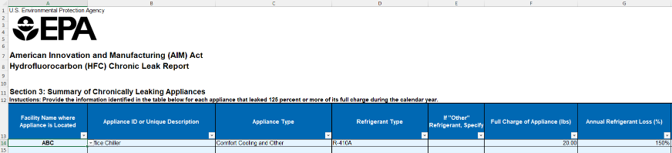
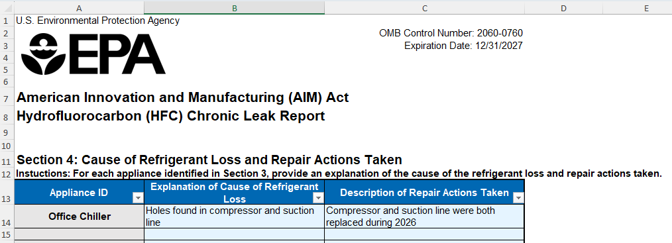
Here’s a quick example to illustrate: Your office chiller with a full charge of 20 lb of R-410A was found empty in May 2026. It was repaired and recharged to 20 lb (all appropriate records, including the leak rate calculation, were retained). In July, the chiller was not cooling and required another repair. The chiller was filled with 10 lb of R-410A (again with appropriate records retained). For the year, a total of 30 lb R-410A was added for a leak rate of 150% during the calendar year [(20 lb May 2026 + 10 lb July 2026) /20 lb full charge x 100 = 150%]. Therefore, this appliance needs to be reported to EPA.
What do you do next?
EPA has published a Clean Air Act & American Innovation and Manufacturing Act Leak Reporting User Guide explaining how to register, prepare a report, and submit it electronically.
Reporting to EPA for chronic leakers is completed through the Central Data Exchange (CDX) HFC and ODS Allowance Tracking (HAWK) System (HFC-ODS-R). Once you have access, you will upload the chronic leaker report to this system.
EPA makes it easy to prepare the report, assuming that you have been tracking all refrigerant leaks and additions during the calendar year. Reports for a company must be combined on a single EPA-provided Excel spreadsheet (Reporting Resources for the Emissions Reduction & Reclamation Rule | US EPA). Each facility is designated in the report and all leaking appliances associated with each facility are reported together. The following information is required for each appliance that leaked 125% or more during a calendar year:
- Basic identification information (i.e., owner or operator, facility name, facility address where appliance is located, and appliance ID or description);
- Refrigerant-containing appliance type (comfort cooling or other, industrial process refrigeration, or commercial refrigeration);
- Refrigerant type;
- Full charge of appliance (pounds);
- Annual percent refrigerant loss;
- Dates of refrigerant addition;
- Amounts of refrigerant added;
- Date of last successful follow-up verification test;
- Explanation of cause refrigerant losses;
- Description of repair actions taken;
- Whether a retrofit or retirement plan has been developed for the refrigerant-containing appliance and if so, the anticipated date of retrofit or retirement; and
- A signed statement from an authorized company official.


How can Trinity help?
The reports for HFC-containing appliances are much more complicated than the reports previously required for ODS-containing appliances. Preparing the spreadsheet may be straightforward; gathering complete and accurate information for each appliance can be more challenging. Trinity’s refrigerant specialists can help determine which appliances are subject to reporting, review service and refrigerant-addition records, calculate annual percent refrigerant loss, and prepare chronic leaker reports.
Contact Trinity’s refrigerant subject matter expert, Jennifer Markwardt via email or 636.256.5652 to be directed to a regional refrigerant lead who can assist you. Trinity can also evaluate refrigerant-management practices, provide customized training, and implement compliance-tracking tools (such as Trinity’s CoolTracker365TM). Contact us today and we can help you get started.


