Cumulative Impacts Rule at a Glance
The Minnesota Pollution Control Agency (MPCA) has developed a draft rule aimed to better protect communities that experience disproportionate exposure to pollution. The Draft Cumulative Impacts Rule is intended to ensure permitting decisions consider not only a facility’s individual emissions but also will require MPCA to consider the cumulative impacts of pollution, such as environmental and social stressors, during the permitting process. The Draft Rule was published on May 18, 2026. Public comment is open on the rule until July 17, 2026. Details regarding the rulemaking process, rulemaking milestones, and informational webinars are available on the MPCA’s Cumulative impacts rulemaking page.
The Draft Cumulative Impacts Rule applies to facilities located within 1 mile of an Environmental Justice (EJ) Area within the 7-county metro area, Duluth, and Rochester, upon taking a permitting action. Registration Option A, B, C, or D Permits, Capped Permits, and General Manufacturing Permits do not have requirements under this draft rule.
The draft rule has three primary “levels” of requirements that facilities may need to meet during permitting actions, as described below.
Initial Assessment
All facilities subject to the Cumulative Impacts Rule will be required to submit an Initial Assessment as part of their permit actions.
The Initial Assessment must contain the following:
- Determination if Project will Impact Health/Environment,
- Site Maps & Diagrams,
- Descriptions of Current Operating Conditions/Permit Limits/Capacities,
- Description of Current Facility Permits (air, stormwater, etc.),
- Environmental Stressors and Assessment of Impact to Stressors,
- Emission Calculations and Comparison against Thresholds,
- Compliance History, and
- Comments on the most recent Cumulative Impacts Analysis (CIA), if relevant.
Environmental stressors can be investigated utilizing the MPCA’s Cumulative Impacts Mapping and Analysis Platform. The tool is still in draft stages but can be reviewed to assess the kinds of stressors nearby your facility.
Note, comparison against Cumulative Impacts Emission Thresholds is required for any permit actions resulting in an emissions increase. Thresholds are described in draft Minn. R. 7007.6050 Subpart 4.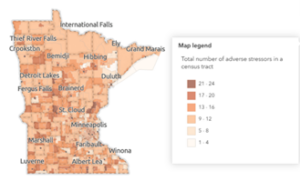
The Initial Assessment is submitted along with the rest of the traditional permit application. Upon receiving the Initial Assessment, the MPCA will determine if the project requires a CIA.
While the determination on whether a CIA is subjective and a case-by-case decision, a few scenarios will always require a CIA:
- Facility is New Construction,
- Emissions Increase Greater than Thresholds,
- Permit Renewal where Enforcement[1] occurred in the last 3 years.
Cumulative Impacts Analysis
Preparing a Cumulative Impact Analysis (CIA) requires a combination of quantitative calculations and demonstrations, as well as public outreach and coordination. A Public Participation Plan must be submitted to the MPCA 30 days after receiving the determination that a CIA is required for the project. The Public Participation Plan must describe timelines for public meetings, methodology for public notification, and more.
The Cumulative Impacts Analysis must include the following components:
- Site Maps & Diagrams,*
- Historic Contamination/Remediation,*
- Climate Change Impacts,*
- Traffic Study,*
- Stormwater Management Description,*
- Odor, Dust, Noise Impacts,*
- Analysis of Permit Limits, Operational Controls, Control Equipment used to avoid Impacts,*
- Public Comments Received & Responses,
- Description of Project Socioeconomic Impact,
- Air Dispersion Modeling (Protocol, Report),* and
- Air Emission Risk Assessment (AERA).*
Items with “*” next to them indicate that this component bears similarity to the Environmental Review requirements. Facilities must incorporate the public comments received during public meetings into the CIA and respond to each public comment.
Upon submitting the CIA to the MPCA, the agency will review the CIA to determine if the project action has Substantial Adverse Impacts. Criteria for determining Substantial Adverse Impacts are included below:
- Model Results are > 50% of the NAAQS/MAAQS thresholds,
- AERA/RASS results > 1 for nonhazard chemicals or > 1 * 10-5 for cancer risk chemicals, and/or
- Environmental stressors in the area, comments received & responses to comments, socioeconomic impacts.
If a Substantial Adverse Impact is identified, the facility will have an opportunity to implement enforceable limits to reduce or eliminate the Substantial Adverse Impact. If enforceable limits are not taken, and the Substantial Adverse Impact remains, the facility must prepare a Community Benefit Agreement (CBA) before a permit can be issued.
Community Benefit Agreement
A CBA is required if the CIA indicates that the project will have Substantial Adverse Impacts on health and the environment. The CBA public engagement process is similar to the CIA process, in that both require public meetings, and incorporation of public comments into the submittals. A Public Participation Plan is required within 30 days of the determination that the project has Substantial Adverse Impacts.
The CBA must include the following:
- Description of Permit Actions and Potential Impacts,
- Identified Community Benefits,
- Discussion of Public Comments, and
- Timeline for Implementing Community Benefits.
It is anticipated that Community Benefits will vary significantly depending on the project action, the community affected by the impacts, and the existing stressors in the area.
The facility’s permit can only be issued after the MPCA gives approval on the CBA. Note, CBAs can be modified after receiving MPCA approval, but there is a specific procedure for modifications.
What Action Should I Take Now?
The Draft Cumulative Impacts Rule can seem daunting upon first review. To help understand the impact the rule may have on your facility, Trinity suggests the following steps:
- Review the Cumulative Impacts Map and identify the stressors affecting the area around your facility.
- Assess your facility’s relationship with the public and work to improve relationships.
- Review future projects at your facility and assess how timelines may be affected by this draft rule. Note, permit actions deemed complete prior to the final rule issuance are exempt from the rule.
Trinity is Here to Assist
Trinity has been following the Cumulative Impacts and related Air Toxics rulemakings closely. For more relevant information, see the webinars and articles below:
If you have questions about the Cumulative Impacts Rule, Trinity is available to support. For more information on this topic, please contact Jena DeRung via email or Trinity’s Minneapolis Office at 651.275.9900.
[1] Violations relating to failed Performance Test, Criminal Enforcement, Monetary Penalty, or resulting in Administrative Order


