Pinal County Nonattainment Updates
In July of 2020, West Pinal County (Figure 1) was redesignated to serious nonattainment (NA) for the 1987 24-hour National Ambient Air Quality Standard (NAAQS) for particulate matter with an aerodynamic diameter less than 10 microns (PM10). When it was redesignated over three years ago, the West Pinal PM10 Nonattainment Area was required to attain the NAAQS by the end of calendar year 2022. In July of 2023, EPA determined that the West Pinal NA area failed to attain the NAAQS. The highest level of nonattainment classification for PM10 is “serious”, so while West Pinal will not be reclassified as a result of the nonattainment determination, it will face sanctions and stricter regulations to reduce PM 10 emissions.
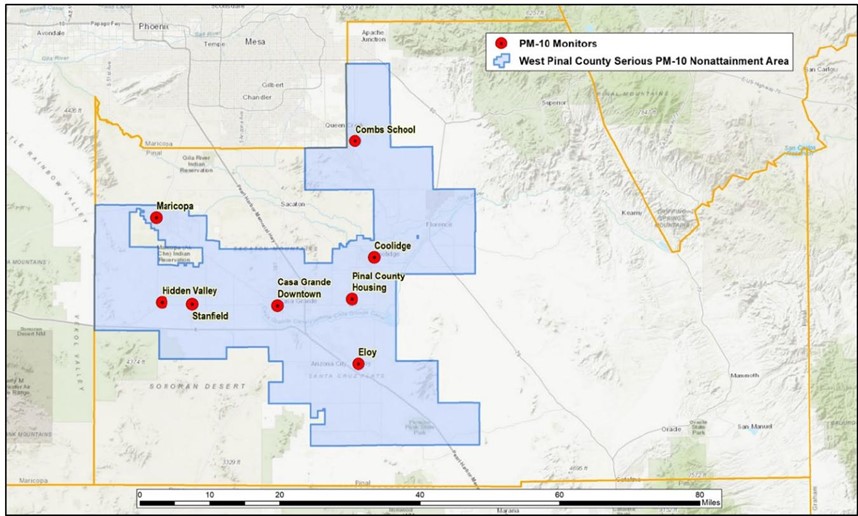
Source: 2022 Serious Area Particulate Plan for PM-10 For the West Pinal County Nonattainment Area, May 2022. Maricopa Association of Governments [MAG SIP]
The Phoenix-Mesa moderate nonattainment area, which includes a small portion of Pinal County, for the 8-hour ozone NAAQS is similarly poised to fail to attain the standard. If it does not attain by August of 2024, it will be reclassified as serious nonattainment for the 2015 Ozone NAAQS.
Both of these have the potential to significantly impact stationary sources within Pinal County Air Quality Control District (PCAQCD) jurisdiction, in the form of sanctions, and sources, in the form of reduced thresholds and increased offset ratios (Table 1). Despite the fact the Pinal County only comprises 5% of the land area of the Phoenix-Mesa Ozone Nonattainment Area, the county will nevertheless be subject to all the same Clean Air Act requirements for serious nonattainment areas (assuming it does not attain by 2024). This would include, in addition to the reductions shown in Table 1, the withholding of federal funding for highway projects and implementation of Reasonably Available Control Technology (RACT) and Reasonably Available Control Measures (RACM).
Table 1. Ozone Nonattainment New Source Review
| Classification | Major Source Threshold (tpy) | Major Modification Threshold (tpy) | Offset Ratio |
| Ozone (including precursors NOX and VOC) |
| Moderate | 100 | 40 | 1.15:1 |
| Serious | 50 | 25 | 1.20:1 |
These RACT and RACM, which PCAQCD is planning to begin implementing this year (2023), will aid in bringing Phoenix-Mesa closer to attainment of the NAAQS but will likely be burdensome to many businesses. Potential RACT/RACM measures could include lower RACT thresholds, stricter product VOC content requirements, stricter dust control measures, and more. Maricopa County Air Quality Department (MCAQD) has already incorporated RACT into their adopted rules, but it will be new for PCAQCD.
To address the PM
10 issue, PCAQCD has been working on a plan (anticipated submittal to EPA in December 2023) to reduce PM
10 emissions by 5 percent every year. This plan is a critical part of the nonattainment area’s attainment demonstration going forward and must be met to avoid incurring further sanctions. The county is projecting a 17.4% reduction in PM
10 emissions by 2026. As discussed in
Trinity’s July 2023 eNews, unpaved roads, windblown dust, and construction activities were identified as the top three contributors to PM
10 emissions in Pinal County. These sources are likely to be the continued target of plans to reduce emissions, as they have already, evidenced by
West Pinal General Fugitive Dust Rule and
West Pinal Construction Fugitive Dust Rule.
As part of this plan, the county identified 70 control measures including:
- 18 that went into effect as agricultural best management practices in November of 2021 (out of 20 total identified)
- 43 that went into effect for construction site fugitive dust control (out of 50 total identified)
New sources can expect to see strict language in their permits regarding fugitive dust control, even for those sources that may not engage in dust generating activities.
Pinal County New Source Review Rules
As new sources move into Pinal County at an increasing rate, the county is working to keep up with processing permit applications and to make sure the permitting program is up to date. As part of this process, Pinal County is planning to make updates to their New Source Review (NSR) regulations. The county has been working on these revisions, but their exact scope and timeline are yet unclear.
Pinal County Air Quality Fees
The fees levied by PCAQCD (including new permit fees and annual fees) have not been updated since 2010. Since 2010, the Consumer Price Index (CPI) has increased by approximately 35%. When Arizona Department of Environmental Quality (ADEQ) recently updated its permitting fees for the hazardous waste program, they made changes in line with the CPI increase. While Pinal County has not yet proposed the fee increases, it is expected that they will also increase according to the CPI.
Transition to IMPACT
PCAQCD is shifting its permitting and compliance to the online EPA Advanced Shared Services (SCS) IMPACT platform. New permits, permit revisions and renewals, and annual emissions inventories will all be prepared and submitted digitally using this platform. MCAQD has already been using IMPACT for these purposes for many years now. PCAQCD has been working on this transition internally but has not released a timeframe for the implementation. Trinity has worked with countless clients to prepare applications and emissions inventories in the IMPACT system in MCAQD and is well positioned to provide support to facilities in Pinal County.
Summary
Many of the changes that Pinal County is going through (PM10 nonattainment, potential ozone redesignation in 2024, NSR updates, and fee updates) have yet to be fully defined, and as such, the potential impacts to sources have not come into complete focus. With regard to potential ozone redesignation, sources should consider authorizing new projects before next August, especially those with VOC and NOX emissions, to avoid the lower thresholds and/or higher offsets. Trinty will continue to monitor developments and provide clients with the most up-to-date information for them to make informed decisions for their companies.
If you would like to discuss these updates and how they may impact your facility, please email Trinity’s
Phoenix office or call
602.274.2900.


